I got back early from Lake Titicaca and had a day and a half free in La Paz (I’m heading further south on a bus tonight). I had another good wander around the Witch’s Market, here are a few photos:


I was fortunate enough to time my visit back in La Paz for the start of the annual Alasita Festival. This festival is centuries old, however it’s changed a little through the times! (I’m paraphrasing here…) Originally the indigenous people used Alasita to celebrate the bounty of the earth, and farmers would bring their produce and sell them at the festival market. When the Spanish arrived they, as a way to weaken the Indian culture and traditions and stimulate trade in their own goods, did their best to do away with the original Alasita festival, banning some things and changing other elements to the festival.
Alasita today is all centred around this little guy with the 1920’s moustache and cigarette in his mouth: Ekeko. There’s one of these creepy dolls in almost every building I went into. The Bolivians believe that Ekeko is able to make all their wants and dreams come true. So, every Alasita, they go and buy miniatures of the all the material things they’d like in the coming year. The Alasita festival is full of stalls selling absolutely everything in miniature: tins of food, cans of drink, sacks of grain, wads of money, work tools, kitchen stoves, electrical goods, cars and trucks and even houses. All these miniatures are then adorned on Ekeko and remain there for the year. It’s kinda cute seeing him loaded up with everything!
It was great to walk around the festival (which sprawled across city blocks and through parks) and soak up a very traditional and particularly unique local Bolivian tradition.


We caught the morning ferry from Copacobana to La Isla del Sol (the Island of the Sun), which lies in the off the southern shore of Lake Titicaca. Apart from its beauty and dramatic scenery, Isla del Sol was used for religious ceremonies by the Incas, and we wanted to check out the remnants that remain on the island.
All the ferry boats on the lake seemed drastically under-powered and it was a good two hours before we chugged into the port at Parte Norte, a small village at the northern end of the island. We walked a further 30 minutes north to the Inca sites: a table used for animal and human sacrifices (!) and the labyrinthine ruins of a palace.


After taking in those sights we decided to walk the three hour path the length of the island to Parte Sur, where the afternoon ferry would take us back to Copacobana. It turned out to be a terrific little hike that followed the ridge all the way there, although tough going in the thin air and in the ultra-strong sun (we were well above the treeline). The views down to both coasts and across the lake were fantastic!


One of the villages on the island with the smaller Isla de la Luna (Island of the Moon) visible in the distance.
I left La Paz on a jam-packed colectivo (minivan) for the town of Copacobana on the shore of Lake Titicaca. It was an interesting mix of people, with a combination of backpackers (four lads from Argentina) and locals heading home from the city. It quickly turned from a basic three hour trip into a bit more of an adventure as the local indigenous (Indian) population had blocked off roads in and out of the city for 24 hours in protest of something the mayor was up to. All the bridges and roads were closed off and we spent a lot of time sitting in the car waiting to see what would happen and whether we would be allowed to pass. At one point I started to walk towards one of the protest marches to see what it was all about but was advised not to by the locals on the van – apparently the protesters wouldn’t take kindly to my interest in their cause!
It turned into a cat-and-mouse game as we paralleled the main road out of the city along dusty tracks waaaaay out of the city (with impressive views of the 6,000+ metre high snow-capped mountains of the Cordillera Real) in an attempt to get around each of the roadblocks. As the bridges were no-go we had to find a place to cross and forded a few of the rivers and streams. At one we were forced to pay a “toll” to pass and it amounted to a quite ridiculous one Boliviano ($0.12!) each.
It turned out to be one of those memorable “aaaaaah just sit back, relax and enjoy it” travel moments – sometimes the old adage that it’s about the journey and not the destination really does ring true (although a kick-arse destination doesn’t hurt!!). It might sounds like a nighmare ride, bumping around in the back of the minivan as we lurched through the outskirts of the city, but I loved it. We all knew we were in it for the long haul and settled in for the duration. I had a great chat to the Argentine lads and the locals (my Spanish lessons are really paying off and I’m pretty chuffed at how much I can get by these days), and one of the guys pulled out a guitar (I was also tickled pink to actually know and follow a few of the songs sung).
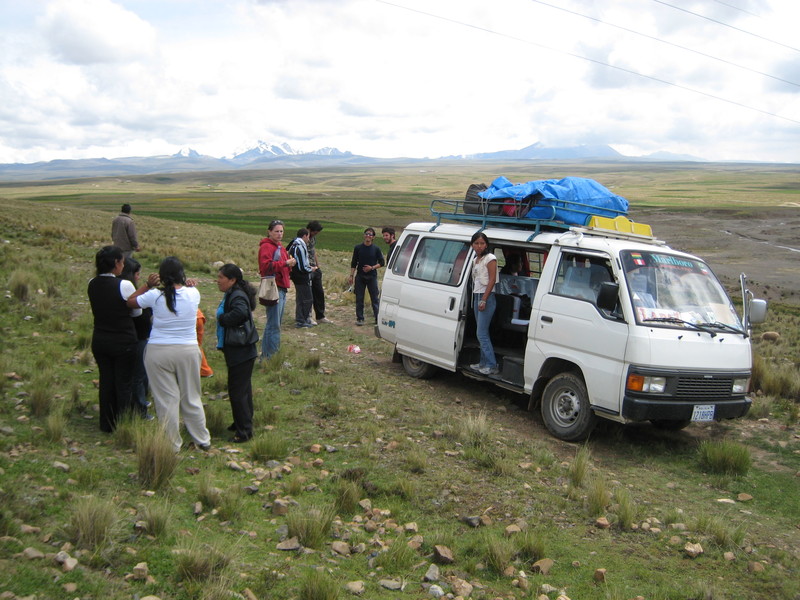

Talk about a detour around the city…! Cute as a button.
It was a good three hours later that we got around the last block and finally got back onto the asphalt. An hour later we arrived at the lake, and crossed a narrow stretch of the lake by ferry before continuing on another hour or so to Copacobana.
Copacobana turned out to be a delightful little town with cobbled streets and some old colonial buildings, set back around a cove on the shore of Lake Titicaca. While I was already acclimatised to the altitude from my time in La Paz (my altimeter was nudging 3,900m on the lake!), it was still quite disconcerting to be walking around in a t-shirt as I’m used to snow and ice and typically freezing and miserable conditions when I climb in the mountains at those altitudes. Crazy…
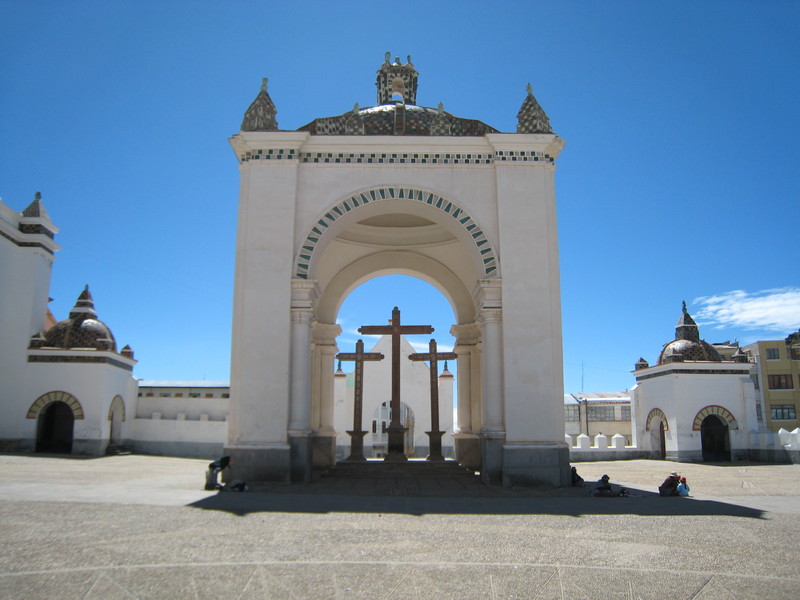
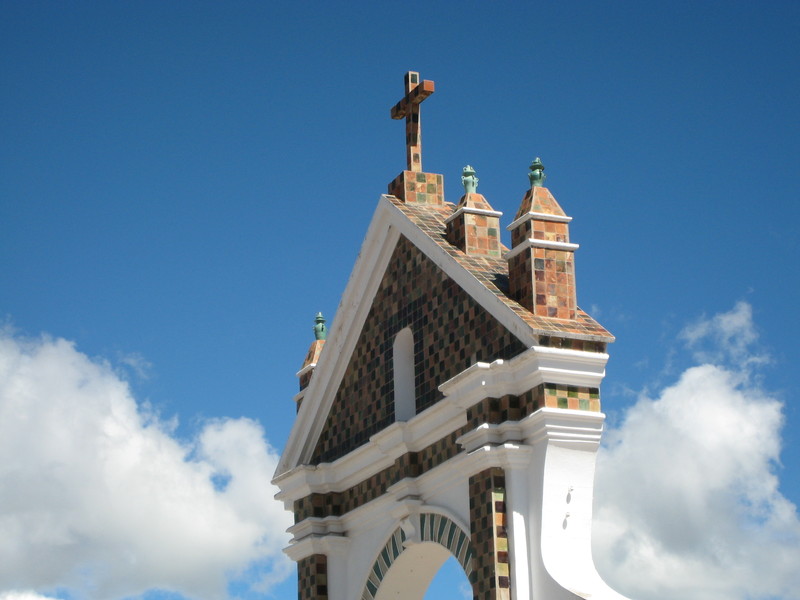
I explored the town this afternoon and really loved the architecture of the whitewashed cathedral that forms the centrepiece of the town. Interestingly, there’s a black “Virgin of Copacobana” statue above the altar inside the church that was carved by the grandson of Tupac, the last Inca ruler.


At sunset I climbed a small hill above the town (and “bagged” another 4,000m peak while I was at it – ha ha…) with a series of small chapels scattered across its summit. The view from the top was wonderful: down to the town below, across a wide expanse of the enormous lake to the north, Peru visible across the other side, and Isla del Sol (the Island of the Sun) not far away.


