I’d been looking forward to a tour of the Potosí mines ever since I first heard it was possible, and it didn’t disappoint ONE BIT! It was easily one of the best adventures I’ve had traveling EVER – and hey that’s saying something…!
First stop was to get kitted out in all the protective gear. We were given some pretty abused clothing (check out my wicked faux leather plastic jacket!), gum boots, a helmet, and a miner’s lamp. Next stop was a trip to the Miners’ Market, where the miners buy all the gear they need for a day in the mines: bags of coca leaves (not to be confused with cocaine!), a rough local booze containing 96% alcohol (that was surprisingly drinkable), carbide lamps (to test for noxious gases), explosives (to go bang!), pipe fittings, shovels, etc.
On our way to the Miners’ Market we crossed a big protest march planned for the day. Apparently Evo Morales (the President, who I think is an idiot) is planning to re-nationalise the mining industry (like he’s doing with the oil industry) and raise taxes, and let’s just say the miners aren’t happy one bit about it. It was a peaceful march, but where other protesters do it with drums or firecrackers, these miners were setting off detonator caps and sticks of dynamite on the street!
After a lesson in what’s what around the market we set off to buy some gifts for the miners. As we’re entering their mine (it’s a co-operative) it’s expected that you come with a few gifts as a token of appreciation. High on their gift list? Coca leaves, explosives, cigarettes and booze! I went for a bag of coca leaves (which really aren’t that unpleasant to chew on, make your lips and mouth go numb, a great for your digestive system, and act as an appetite suppressant…) and an explosive “kit”. For just 17Bs – that’s around $2! – anyone can score a ready-made bomb-making kit consisting of a stick of dynamite, a detonator with a one-minute slow-burning fuse, and a small bag of high-concentrate ammonium nitrate fertilizer (which is an explosive when used in the right – or wrong – way).


(L) Fun with dynamite! (R) Our guide explains the virtues of coca.


A few scenes from the Miners’ Market…
Next stop was a visit to one of the many small ingenios (smelters) that are used to process the ore from the mines. These are all along the old riverbed (the river dried up over a century ago) as the plants were run using the water to turn huge waterwheels. Here the ore is crushed up and water added to create a slurry sort of paste, chemicals are added, the mixture is agitated, and a flotation method is used to separate the silver. The result is silver of about 60% purity, which is then sold on international markets. The by-product liquid from the flotation process is further separated and settled, and the remaining “mud” is dried in the sun. This is also about 60% silver and tin (with zinc and copper in there as well) but as the Bolivians don’t possess the technology to separate out the ore themselves, the “mud” is sold to companies in the US and Europe for further processing and value-added activities.


Inside the smelter.
With all that behind us we drove up to Cerro Rico to the Candelaria Mine (at 4,200m altitude!), which has been worked for several centuries. We walked in a couple of hundred metres to a small “museum” which explained some of the history of the area, and then the tour begun in earnest. We started at a small shrine to El Diablo (the devil), who the miners call Tío (Uncle). When the Spanish invaded the Americas they brought their Catholicism with them and quickly instilled an image of heaven and hell into the indigenous mining population, and as the mines were a pretty close approximation to the biblical version of hell (underground, hot, not much fun!), the miners felt that mining underground was like taking something from the devil. So, before each shift, the miners make offerings to Tío to appease him for “stealing” what is rightfully his. The offerings are the usual: coca leaves, booze and cigarettes.


Views from up near the mines.


(L) At the entrance to the mine. (R) A shrine to Tío with offerings to him.
We then entered the working part of the mine, full of narrow and irregular passages that follow the veins of ore and some fairly rudimentary shoring-up where necessary. The temperature climbed substantially and the air took on a foul, noxious and acrid tang that made it difficult to breathe, which stripped my throat raw and which smelt sharply of nitrates (used in the explosives). To climb down from the first to the second level (some 30m below) we had to slide down an old timber incline that was used to haul trolleys of ore from level to level. It was about 40 degrees steep and quite dodgy in parts! Down at the second level we saw a group of miners sifting by hand through rock that had been blasted the previous afternoon and splitting it with a mallet. The dust was choking! After a scramble down to the third level we saw rock being loaded onto the trolley to be carted up to the surface – and hey who am I to shy away from some hard yakka, so I picked up a shovel and gave it a go myself (to the miner’s great amusement)! It was the true definition of hard work: oppressive heat, thick dust, foul gases, and all in such thin air at high altitude. Almost everything we saw down in the mine was done by hand by the teams of miners that spend 8-12 hour shifts underground. Incredible…


(L) Down the incline we go… (R) Choking dust!
Once we left the mine we still had some more excitement in store. A couple of us, myself included, had bought an extra explosive kit for “recreational purposes”. We were shown how to break up the stick of dynamite, push the detonator into the middle of the explosive, wrap the bag of ammonium nitrate tightly around it and bundle the whole thing up in a small, neat package. Turns out that that tiny little thing I’m holding in my hand (see pic below) packs enough punch to break up about eight tons of solid rock! Once the fuse was lit we had one minute to snap a quick pic with the fuse fizzing away, place it some distance away and then run like the clappers! KA-BOOM!!


(L) My package is ready to go “boom”! (R) “Ohmygod she’s gonna blow!!” (and yes the fuse was actually lit at this moment – sorry Mum!)
In all, I have to say the tour gave me a fairly shocking first-hand experience of working conditions as they are through much of the developing or undeveloped world. Now that I’ve seen what goes on “behind the scenes” it’ll definitely make me pause for thought before I next go and buy some silver jewelery. But, like all things, it’s a trade-off. These miners evaluate the risks to their health as being worth the $10 a day in wages theyr eceive, which is a startlingly high amount of money to earn here in Bolivia, especially given that two-thirds of the country are considered poor and half either unemployed or under-employed.
With the tour over, we ventured back into town mid-afternoon and found the protest marches still going on full swing. The miners had all headed back underground but other groups were taking their chance to air their own grievances. Here are a few images of some of the locals in the town square – they look like a pretty harmless bunch?!


After a refreshing shower to clean up, I had a bit of the afternoon spare and went for a final wander around the town. I made my way to one of the town’s many beautiful churches, and while the interior wasn’t too exciting, I was invited to climb up to the roof for some fantastic views of the town and surrounding mountains.


A mining town might be a strange final destination in Bolivia for me to choose, but as it says on the city’s coat of arms, “rich Potosí, the treasure of the world, and the envy of kings” is no ordinary mining town!
The city was founded in 1545 after rich silver deposits were discovered by the Spaniards in the aptly named Cerro Rico (Rich Mountain) nearby. Even the town’s altitude (4,090m, the world’s highest city!) couldn’t stop Spanish greed and the Potosí veins of ore quickly came to be the world’s most prolific, lucrative and valuable. By the end of the 18th century Potosí had come to be Latin America’s richest city and one of the largest in the world at that time, and that history has left the city with a wealth of lovely colonial architecture to boot. The silver from Potosí was of such importance that it underwrote the Spanish economy and its monarchs for over two centuries. I love that, even today, anything invaluable or lucrative is described in Spanish to be vale un Potosí (worth a Potosi). This should be a fascinating couple of days…
Another rough and bumpy six hour bus ride brought me from Uyuni to Potosí (which included one break-down which required some running repairs to the radiator with what looked like chewing gum) and the route took us across some beautiful mountainous but arid countryside. I’m amazed that the shocking dirt track into Potosí was the best they could have come up with after 450 years!!


Our busted-arse bus. Llamas!
Once I was dropped off at the bus terminal I walked up a gasping couple of blocks (I’m acclimatised but the altitude still takes its toll…) to a nearby hotel and checked myself in. I then went off to explore the city a little bit at last light.


That was yesterday. Today I’ve been exploring the city and trying to see some of its museums, churches and other historic buildings. Turns out that Sunday isn’t the day to do anything around here as most things are shut (including many of the churches?!). But I had a good wander around nonetheless.


A few street scenes.

Inside the old fortress-like Mint where the silver was melted into coins.


Convento de San Francisco. Torre de la Compañía de Jesús.
The true highlight of a visit to Potosí is a trip down into the mines themselves, and I’ve signed up for a tour tomorrow with an agency after spotting their “guaranteed at least one dynamite detonation” advertisement (“Really? Where do I sign up?!”). Forget your sterile “western-style” mine tour with all that fancy safety equipment and zero risk of danger, this one should be like going back to the Dark Ages…
Most of the mines in Bolivia are co-operatives that are owned and worked by the miners themselves, and methods down there haven’t changed much in centuries. Most of the work is still done by hand in appalling conditions (4,200+m altitude, temperatures varying from below zero to 45 degrees Celcius, many noxious gases etc.), and a miner typically lasts less than 10 years before dying of silicosis pneumonia or losing so much of their lung capacity that they can no longer work. Here’s the most shocking statistic I’ve found: it’s been estimated that in three centuries of colonial rule – 1545 to 1825 – as many as eight million Indian and Africans (slaves, brought over by the Spaniards) died as a result of the mining. The slaves would work 12 hour shifts for four months at a time underground before being brought to the surface. Incredible!

Cerro Rico (Rich Mountain) looms right above the city.
One of THE highlights of Bolivia is the incredible Salar de Uyuni, the world’s largest salt flat. It’s a mind-boggling 12,106 square kilometres in size and sits at an also impressive 3,653m altitude.
Like all things in Bolivia it turned out to be a bitch to get to. It was a nightmarish 13 hour night bus ride south from La Paz along the altiplano, all of which apart from the first three hours were along some of the worst dirt roads I’ve ever had the experience of enduring. What’s even more amazing is that the road is THE main “highway” south from La Paz towards Chile and Argentina (I use the term “highway” loosely as I’m not sure you can call a dirt road a highway anyway, especially when the max speed possible is about 40km/h)! I arrived at the small little dusty town of Uyuni, which couldn’t be more in the middle of nowhere and which forms the centre of the salt processing industry around the lake. It was a pleasant little town with absolutely nothing to do, the sort of place everyone passes through on their way to somewhere else. As I also observed it was the sort of place with a trucker’s calendar on every store wall showing a ridiculously busty woman with big pechugas (quite a surprise in conservative and Catholic Bolivia!). Anyhoo with other things on my mind I checked into a cheap hotel, arranged a day tour out to the Salar later in the morning, and grabbed some brekkie.
We started the tour with a visit to the Train Cemetery. Uyuni sits on the rail line connecting central Bolivia to Chile and Argentina, and for some reasons all these century old steam engines ended up here at the “end of the line”. It was quite a surreal sight!


We then drove 20km north to Colchani, where most of the salt processing is done, and drove onto the Salar. For three months of the year over the rainy season the lake is partially covered with a thin layer of water, and we were fortunate enough to see this. After the first 30 minutes or so of driving the salt dried out and we were left with a blinding expanse of white as far as the eye could see.


We drove across the Salar some 70 kilometres to the Isla de los Pescadores (Island of the Fishermen – don’t ask me why because there’s certainly nothing to fish!), a lone rocky outcrop in the middle of the lake covered with the most incredible Spaghetti Western-style cactii you’ve ever seen (some in excess of 10m tall and 1200 years old)! We relaxed and ate lunch there (“Pass the salt please” – ha ha), and had time to explore the island and climb to its rocky peak.


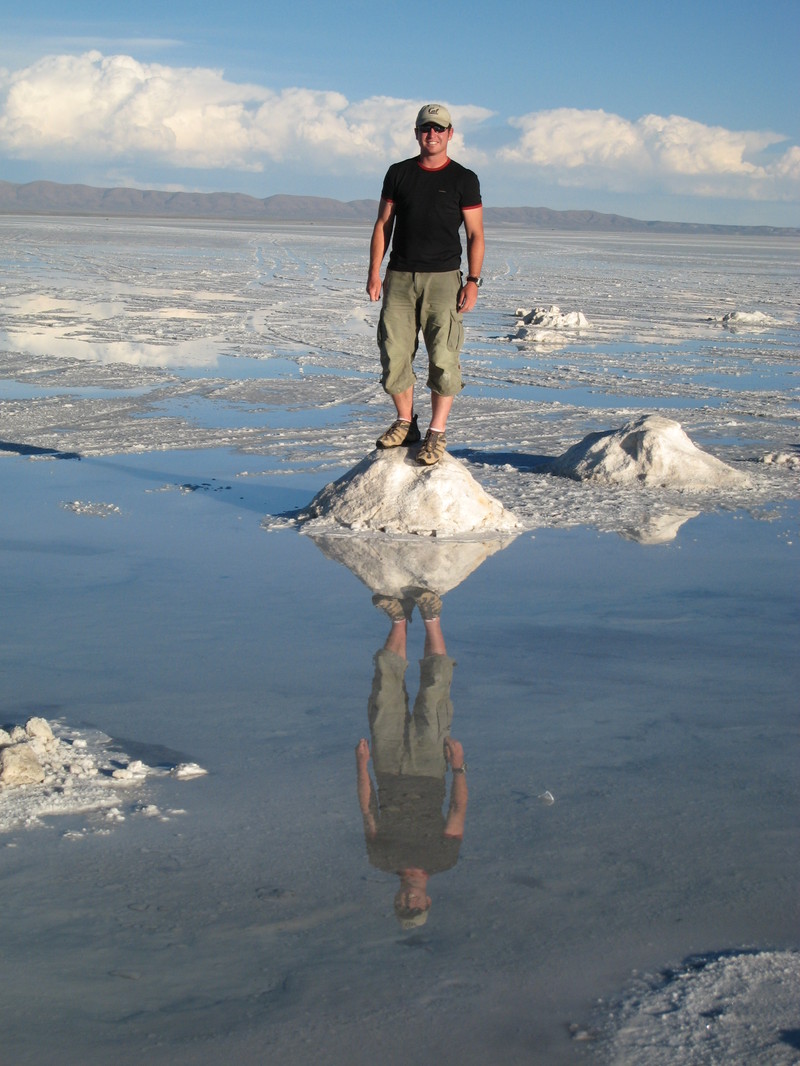
We drove back out of the salk lake the way we came in and arrived at the edge of the lake just as the sun began to set. Fortunately for us the lake had seen some rain in recent days, and the reflections in the shallow water were outta this world!!! Definitely one of the more memorable and stand-out sunsets I’ve seen!


p.s. Happy Australia Day everyone!!! Hope you’re all celebrating it in style… I spent the evening with a bunch of Aussies at the hostel who were so incredibly “Oz” they made me cringe!