Aaaaah, it’s great to be back in the city…!
I’m in my apartment again and straight back into the swing of things here. I’m also taking another dose of Spanish classes (private this time), but damn if it didn’t get really bloody hard all of a sudden!!! Looks like I’ve moved past the easy peasy bits (although I’d swear the pronouns will be the death of me…) and I’m neck deep in the tricky stuff now. There are some things that really have me bamboozled, like the subjunctive form for example. It’s a throw-back to Spanish’s Latin roots, could easily be made redundant (many people don’t even use it), and it has the most illogical and unintuitive grammar you could ever imagine. I’m starting to doubt I’ll ever get my head around it – I’ve been at it for four solid days already now and I’m left with a cracking headache each time the class ends!
Of course I’ve been lapping up some more of this fantastic city as well. In an earlier post I had a few descriptions of some different areas of the city, so here are a few more:
San Telmo: One of my fave neighbourhoods nearby where I live with cobbled streets, some beautiful old buildings, antique and grunge clothing stores, a delightful old square surrounded by restaurants and bars, and loads of style and old-school class. On Sunday the streets fill with arty market stalls and buskers and it’s a great place to chill out and wander.


 Tango music on the streets.
Congreso: The gritty part of the city where I live. Close to the language school and convenient to many parts of the city.


(L) Home sweet home (upstairs on the right). (R) My street corner: Virrey Cevallos y Belgrano.
Recoleta: One of the classier residential neighbourhoods in the city with some pretty tree-lined streets. There are a few good museums there but the highlight is the somewhat quirky and very eerie Recoleta Cemetery, where Argentina’s “royalty” (i.e. the rich) are buried in chapel-sized mausoleums. Famous “residents” include Eva “Evita” Perón.


Plaza de Mayo: This square in the centre of the city is surrounded by a ring of stoic buildings, and at its eastern end is the pink-hued Presidential Palace, La Casa Rosada (which is currently shrouded in scaffolding). This palace is the location of Evita’s “Don’t Cry For Me, Argentina” balcony. Interestingly enough, people are quite divided about Evita’s legacy (conversely, Madonna playing Evita in the film is reviled by everyone!). While she was known for her social programs, at the end of the day she was still a part of her husband’s aggressive and quite brutal political regime.


El Retiro & Plaza San Martín: At the end of Calle Florida, up on the hill above Retiro train station, is one of my favourite parks in the city. It’s a great place to chill out and people-watch.


Palermo: Choc-full of great bars, restaurants and clubs (it’s usually where you end up at 2am in the morning), Palermo also has some lovely parks and open spaces. Some of its streets, with their cobbles and plane trees, really remind me of parts of Melbourne.


La Boca & Caminito: La Boca (The Mouth) is located down at the docks at the river entrance and is one of the poorer barrios in the city. It’s generally unsafe and not noteworthy, however there’s one cute little part down near the water called Caminito. In days gone by the dockworkers painted their corrugated iron shacks in all manner of bright colours. These days it’s been taken over by tourist shops, uber-cheesy restaurants and tango couples busking on the streets.


While I’m at it, here are a few great memories of life in the city (I’ll add to the list as I think of more):
- Empanadas! An Argentine classic and yummo.
- ESPN+, a sports channel that finally caters to the rugby connoisseur – you can’t even find that in the US! Or Europe. Even the local club games get coverage.
- Parrillas: cheap, good food and a cosy atmosphere on every street corner.
- Sharing a yerba maté (traditional Argentinian tea) with a couple of porteños.
- Tango classes! Another cheapie at just a couple of dollars for a two hour lesson, and heaps of fun! (I wish I’d taken dancing classes at school now…) And the tango milongas are a really fantastic local experience.
- Buenos Aires’s Italian heritage has left it with a great legacy of yummy pastries. One of my faves is a soft biscuit called an alfajor with a filling of dulce de leche, Argentina’s answer to caramel.
- I love the fact I can travel half way around the world and find a thriving rugby community here (FYI Argentina is ranked a very respectable #6 in the world right now).
- Some of the old Victorian (19th Century) architecture reminds me of Melbourne (especially with the plane trees), other parts of Paris.
- The taxis are super cheap here and readily abundant, and you use them to get all over the city. I’ve had some great chatty conversations with some of the old timers, including one that used to be the Aussie Ambassador’s driver (and was extemely proud of the fact, even down to the kangaroo pin he still wore), and it’s been a fab way to practice my Spanish!
- Seven peso ($2) cinemas – you gotta love it!
- This city is a night owl’s dream, going out to dinner around 11pm-midnight and off clubbing from 3am until the sun comes up.
- Choripan (fat, meaty sausages in rolls) lunches in the park with friends.
- Lots of protests and strikes. There’s something being protested every day on Avenida de Mayo, and gee those Subte workers are a sympathetic bunch…!


Midnight dinner at Campo de Fiori, one of our fave local haunts a few blocks from home. Love the lampshades!

Yet another night out, more drinks…


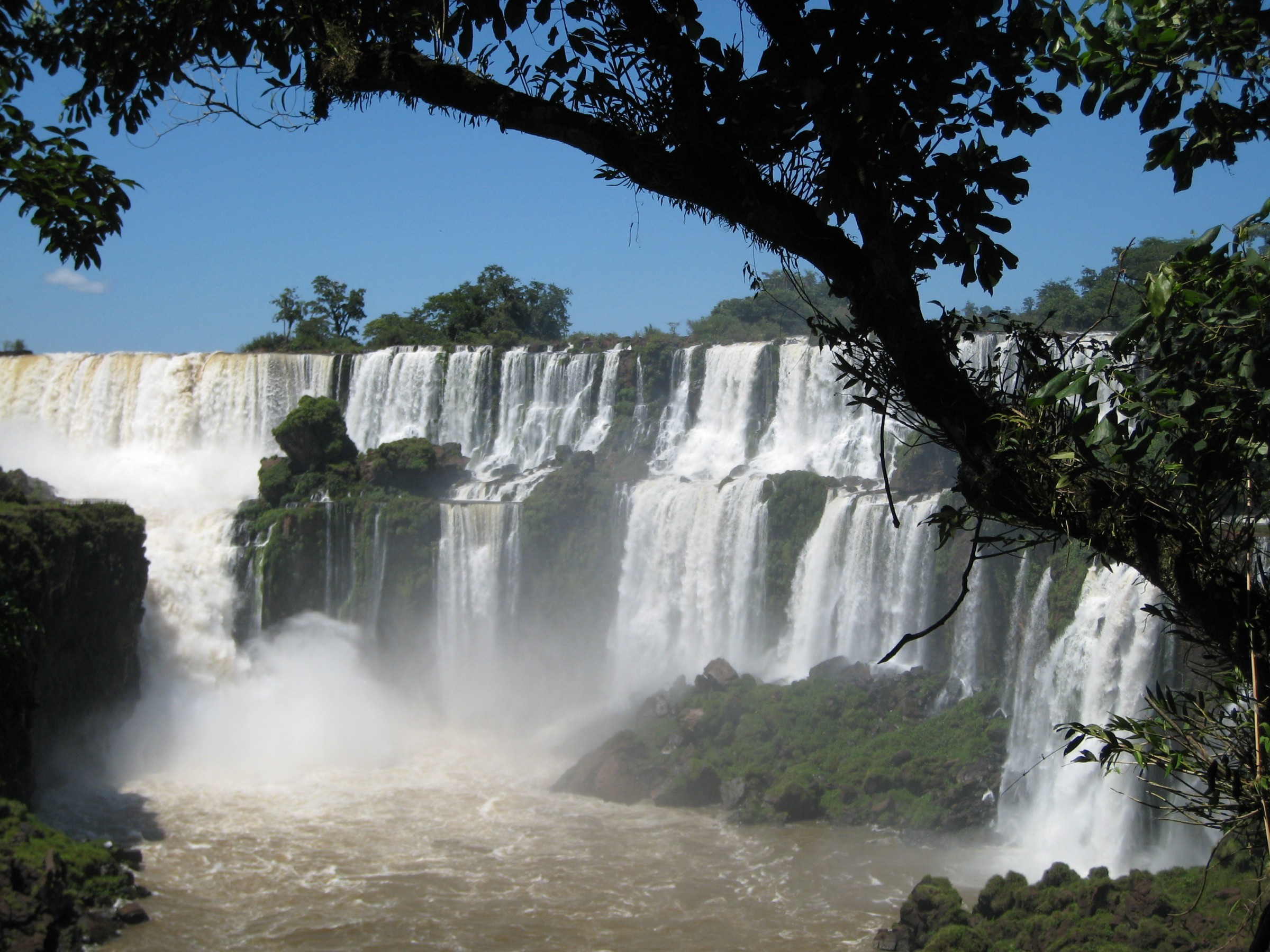
Talk about saving the best for last! With Bolivia behind me, I had one last destination I really wanted to see in Argentina before heading back to Buenos Aires for my final stint in South America: the falls at Iguazú! I’d been told by many people that they’re one of the most impressive natural sights in all the world and definitely shouldn’t be missed.
After just one brief night back in my apartment in Buenos Aires (my flight from Bolivia was routed through BsAs) I caught an early morning flight up to Iguazú, right up in the north-east corner where Argentina, Brasil and Paraguay all meet. I hadn’t made a reservation but I showed up at the Hostel Inn HI hostel, which I’d been told was the backpacker place to stay at in Iguazú. Now I have to admit I’m not a big fan of HI hostels as they attract a certain kind of “independent traveler” that makes me cringe (the kind that isn’t independent at all…), but this hostel didn’t disappoint! It had a swimming pool, bar, pool tables, free internet, the works.

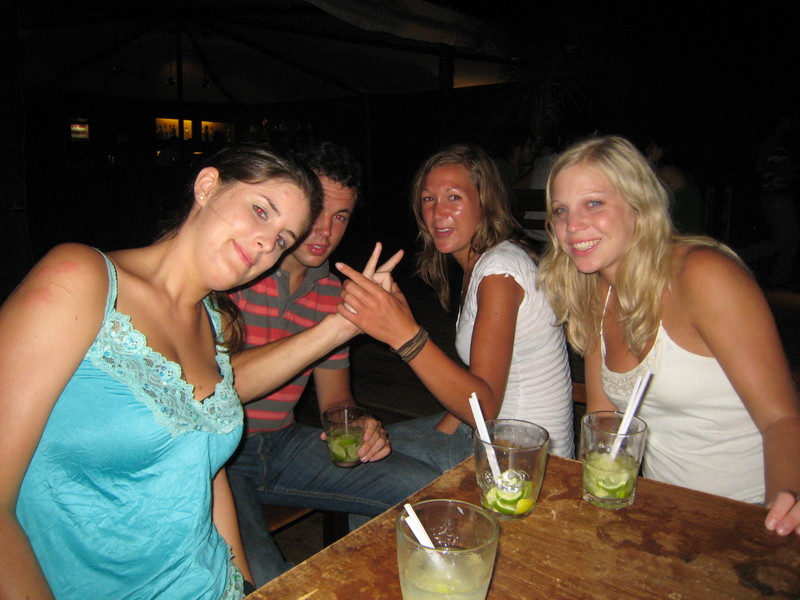
Not bad for $10 a night…
My first view of the falls was truly magical. Around the full moon, the national park offers a moonlight tour of the most spectacular part of the falls, called La Garganta del Diablo (the Devil’s Throat), and as I’d heard rave reviews about the night tour I quickly signed up for it. After sunset we were driven to the park and traveled 15 minutes along the narrow gauge railway to the start of the walkway to the Garganta del Diablo. From the train it was a 1km walk in the darkness (it was a perfect evening with a clear sky and bright full moon) along a catwalk over the water to the edge of the falls. We could hear the rumble and see the plume of spray rising up as we approached, but it was only when we turned the last corner that we finally saw the falls. All I can say is WOW! In the darkness you could just make out a truly incredible amount of water spilling down off a horseshoe-shaped cliff and plunging down into the darkness below. Unfortunately my poxy little camera could take an exposure long enough to capture it, but I’m hoping to get a couple of photos from a few of the travelers I met who had SLRs with them. After about 30 minutes enjoying the spectacle we were taken back to the park entrance and enjoyed the free caipirinhas on offer.
The next day I decided to do the more extensive Argentinian side of the falls (Argentina gets the lion’s share of the falls, Brasil just gets a toe-hold of one small corner but has great views looking across to the Argentinian side). I arrived at the falls early morning and walked the Circuito Superior, a trail that follows upper level of the falls.

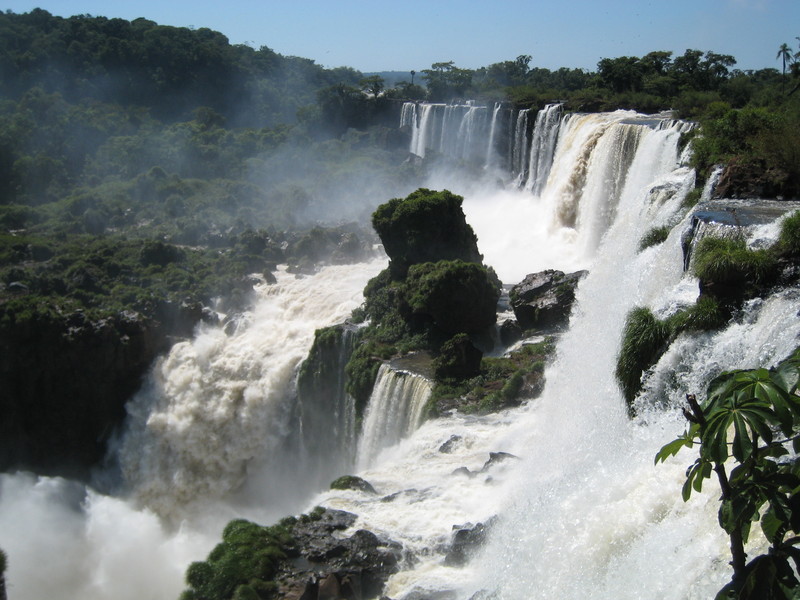

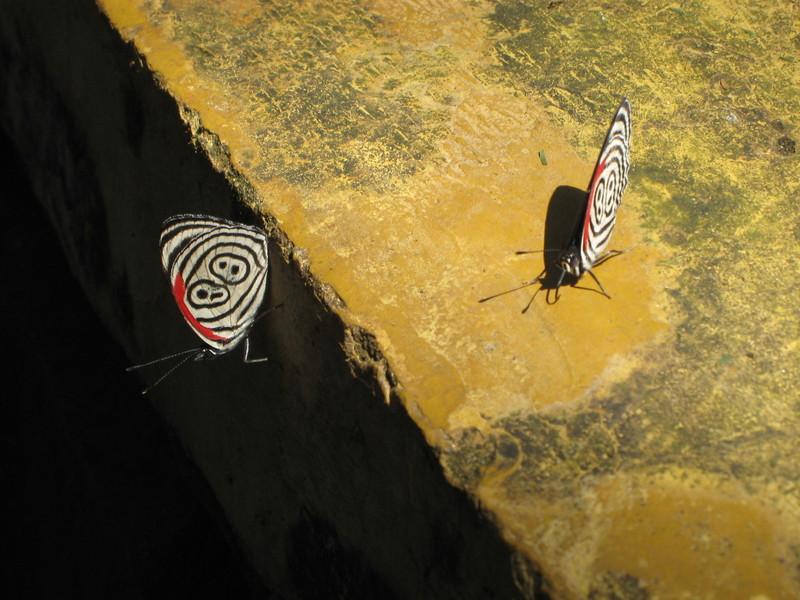
The falls are surrounded by some beautiful tropical rainforest, and throughout the day I saw loads of wildlife. There were more butterflies than the best butterfly house I’ve been to, loads of coatis (one of my favourite little critters), some guinea pig/capybara looking things, and many different kinds of birds. No jaguars though, although they are about – in 1997 a park ranger’s child was taken by one!


After completing the Circuito Superior it was time to delve down into the Circuito Inferior, a more extensive path that explores the mid-level and lower sections of the falls. Usually this includes a boat ride across to Isla San Martin, but were were told that as the river was too high the island was closed (pros and cons, while we missed out on some of the views we knew we were seeing the falls really gushing). I spent about two hours wandering along the path, enjoying some of the most beautiful views imaginable. Nature couldn’t have designed a better series of waterfalls and cascades, all set around some lush, green rainforest packed full of wildlife.
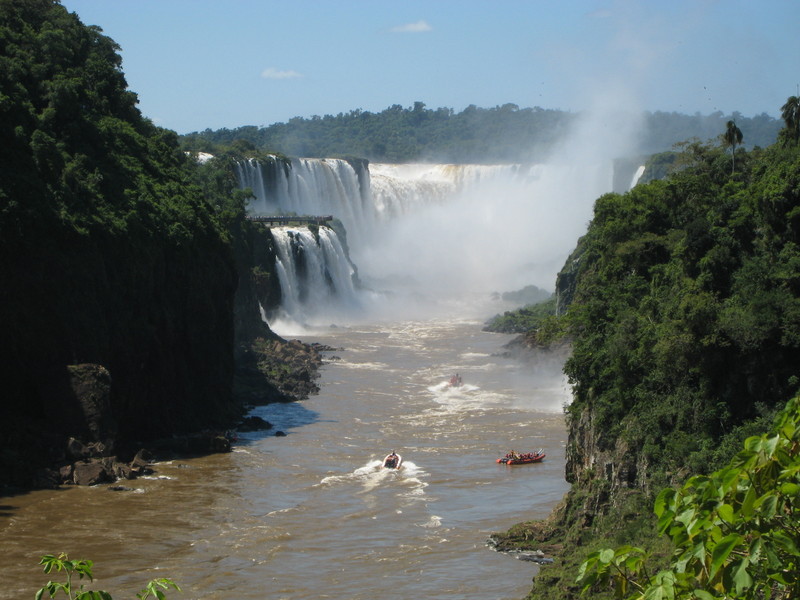

(L) Looking towards Garganta del Diablo. (R) Salto San Martín and other falls.


Down by the river I paid 45 pesos ($15) for La Aventura Nautica, a 15-minute boat ride further up both branches of the gorge. We were told to put all our belonging into waterproof bags and I soon found out why – the boat motored right up close to a few of the huge waterfalls cascading down and we got completely drenched from the spray! The grand finale was driving right up close to the Salto San Martín, the largest waterfall in the photo above. Trust me when I say it was $15 well spent!!


One of the boats heads into the Salto San Martín waterfall.
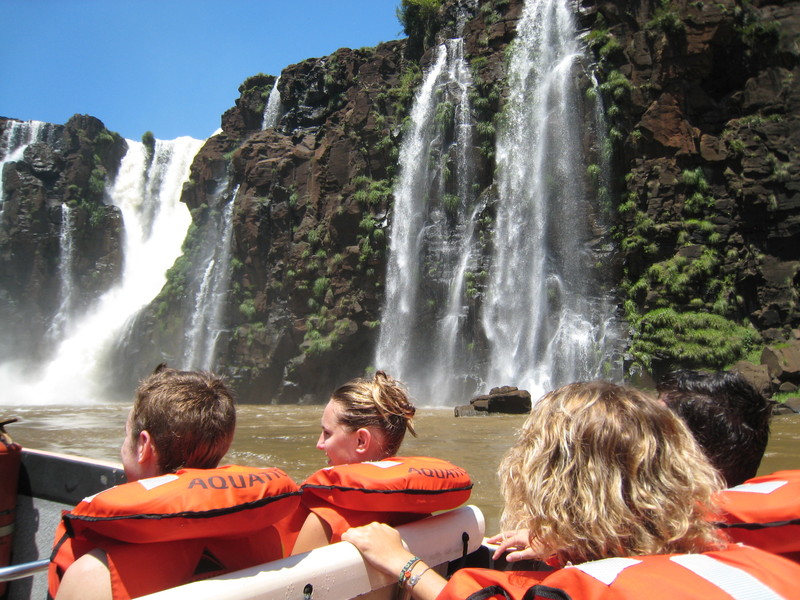 Heading up towards La Garganta.
Having already seen La Garganta del Diablo by moonlight, I knew what I was in for and decided to save the best for last. Having seen the other falls I caught the train up to the beginning of the boardwalk and excitedly walked the 1km route to the edge of the Garganta (I saw a giant otter on the way). It was even more impressive during the day than at night, and it really took my breath away. It appeared like the whole world was draining into this hole in the earth, as you couldn’t see the bottom of the falls from all the spray. I stayed there about an hour, hypnotically watching the water plunge down over the falls. Fantastic!


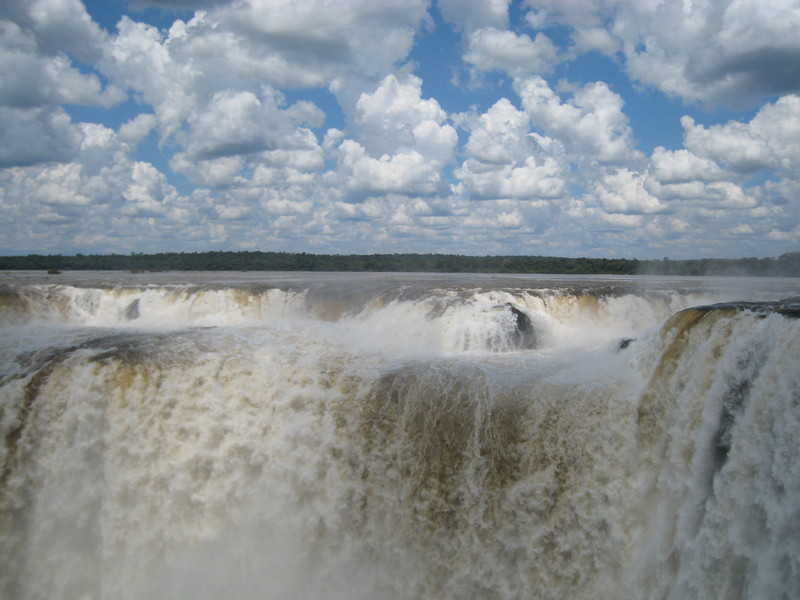
Some views from La Garganta del Diablo. Trust me when I say these photos don’t do it justice!!! “Awesome” is the only word to describe it.
The next day I had the choice to head over to the Brasilian side but decided against it. The weather was a bit iffy (it was cloudy, grey, and poured down later on), it was a hassle to get across there over the border (and there was a chance I’d need to purchase a $35 visa), and I have to admit after exploring the Argentinian side of the falls I wasn’t sure that the Brasilian side could out-do what I’d already experienced. Instead of heading over there I chilled out by the hostel swimming pool before heading back to the airport in the afternoon. It was while I was lying by the pool it kind of hit me: this is the end of my Grand Tour! Iguazú is my final travel destination before I head back to Buenos Aires and then Australia – and I definitely finished on a high! And this hostel is the last one I’ll stay in, for a long time if not ever (I am DONE with dorm rooms). It’s kinda weird to think it’s all coming to an end…
Anyhow I’m back in Buenos Aires now for one final dose of this awesome city, and it’s not long until I’ll be packing my bags one final time to head back to Australia (I need to get back there to organise my US work visa). I’m using the chance to take some final private Spanish lessons, and I’ve also got a million and one things I still want to see and do around the city. It’ll also be good to see some of my friends again, although there’s been a bit of turnover since I was last here and many of my friends have either returned home or are off traveling around Argentina and Chile.
Back in La Paz, and with a day up my sleeve before I was due to fly back to Buenos Aires, I had the chance to do something I’d heard rave reviews about from some fellow travelers: mountain biking the “World’s Most Dangerous Road”!
The road in question is that which connects La Paz to Coroico, north-east of the city. Until the new bypass road (two lanes wide, sealed the whole way, an engineering marvel given the steep terrain it covers) opened just weeks ago, the old gravel road was the major thoroughfare connecting the capital to the northern reaches of the country. It isn’t just any old gravel road however! Outside of La Paz the road climbs to the mountain pass at La Cumbre, some 4,600m high, and then plunges deep into a mountain valley. About half way to Coroico, which lies at 1,600m altitude (3km below!), the road begins to follow an old Inca trail cut into the mountain side. Back in the ’30s the road was widened to accomodate a single vehicle at its narrowest sections, and what resulted was the “World’s Most Dangerous Road”. This label was given by the Inter-American Development Bank due to the number of fatalities that occurred along this particular stretch of road. And we’re not just talking about the odd car plunging off the cliffs here, we’re talking about buses ands trucks with sometimes 40, 60 and even 80 people aboard! Yikes!!
Numerous tour operators to mountain biking trips along the road, but I’d heard a few great reviews about “Downhill Madness” (one of the higher-end tours) so I chose to go with them (thanks Sarah for the heads-up!). The tour started early in the morning and we got kitted out in jackets, protective pants, helmets and gloves, and of course our bikes. We piled onto the bus and drove about one hour up out of the city to La Cumbre (4,600m). Our guide for the day was Aaron, a pretty mad Englishman who reminded me of those two “extreme” guys from BBC’s The Fast Show with his cries of “let’s offroad!” and “yeah, hardcore!”
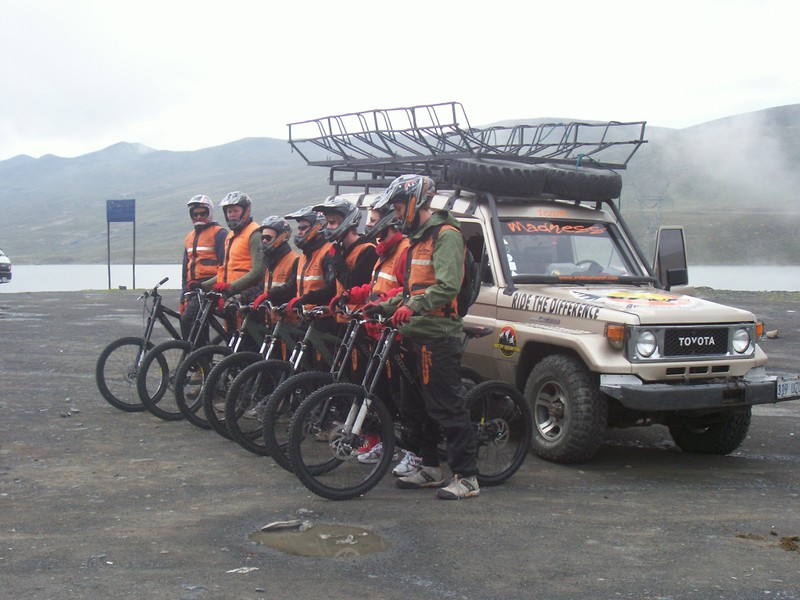 The team, ready to roll…
Once we were all ready to go we started the descent along a nice section of sealed road with twisting corners. We roared along at 60+km/h and were descending at something like 50m/min in parts, and I can honestly say that for the first 30 minutes at least my feet didn’t touch the pedals! After about an hour of riding we arrived at the junction where the old “dangerous” road peels off from the newer bypass road. After a safety briefing from Aaron we started flying down the old road. Even though the weather was crap the views were outstanding as we rode along this “ledge” cut into the mountain side with overhanging greenery above us and a good 500m drop off the other side. With all the rain the rocks and gravel lacked some solid traction, but with front suspension and disc brakes on the bikes it was easier just to keep some speed and bounce over the bumps at a fairly frighful pace.


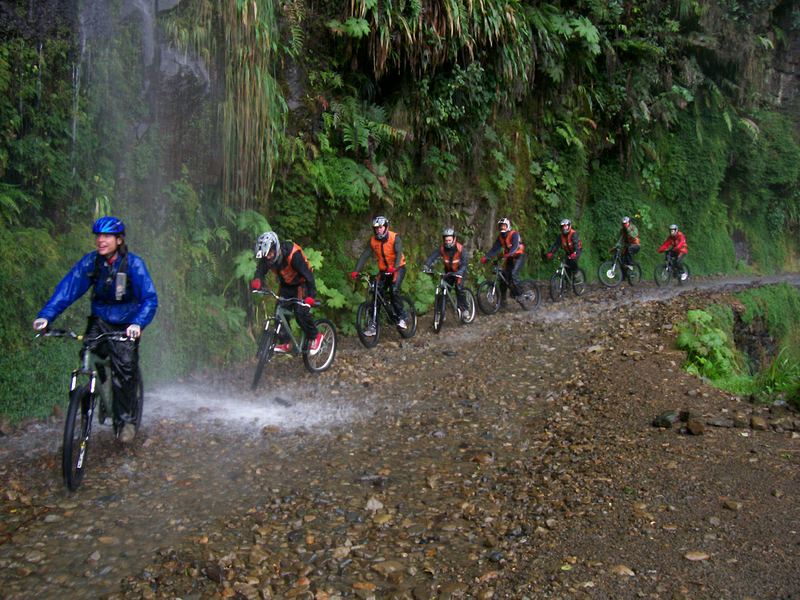
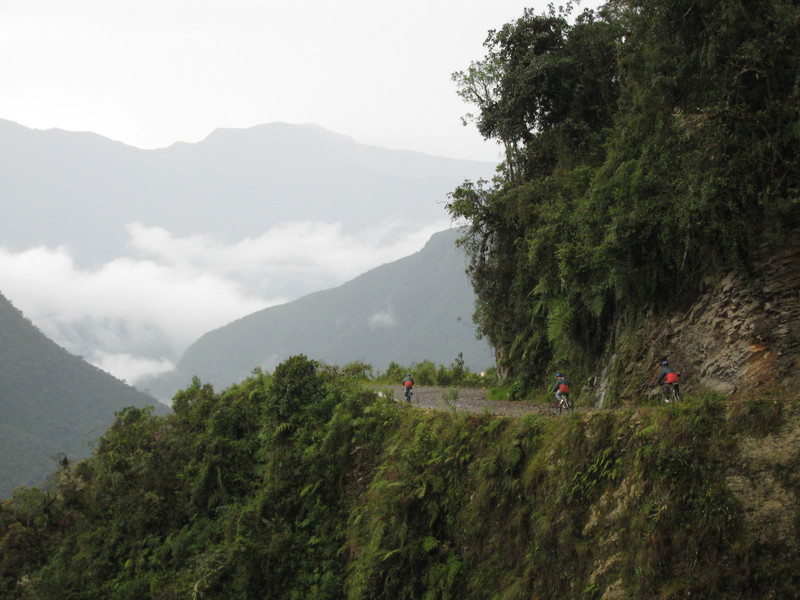
It was a good couple of hours roaring down this track until Coroico came into view. As we descended we noticed the vegetation change, and the scenery around Coroico was lush and green. The temperature rose too, from decidedly cool at 4,600m to hot and steamy down at 1,600m. Once we finished the ride we packed the gear back onto the support vehicle and drove to a hotel up near Coroico. We had lunch there and chilled out for a couple of hours before driving back (along the new road) to La Paz. The hotel was situated on the hillside with expansive views down to Coroico and the valley floor below and green hills and snow-capped mountain above. They had a decent sized swimming pool, and a sauna which I took great advantage of. It would be a great place to spend a couple of days!


