After the deserts around Dunhuang I was keen for a change of scene, and jumped on board a 14-hour night train to Lanzhou, the capital of Gansu province. It was an uneventful train ride along the Hexi Corridor, a famous strip of land wedged between the mountains of Qinghai and Tibet and the deserts of Inner Mongolia. In ancient times it was the only way out of the Chinese kingdom towards the west, and was therefore an important part of the Silk Road route. There were numerous important cities scattered along the route including Jiayuguan, whose fortress marked the western boundary of China back in the good ole days (the Great Wall in fact terminates there).
Lanzhou has the unfortunate reputation as being the most polluted city in China (and that’s saying something!), so I had no desire to stay there one second more than I had to. After a bit of faffing about I was able to work out my bus connections south towards the important Tibetan Buddhist city of Xiahe (pron. “Shah-huh”). I got there at sunset seven hours later and checked myself into a cheap but friendly Tibetan guesthouse.
Xiahe is about 3000m up on the eastern edge of the Tibetan plateau, on the border between Gansu province and Qinghai province to the west. In historic times the area was part of Tibet, but Chinese divvying up and meddling meant that bits of Tibet ended up in Sichuan, Gansu, Qinghai and other provinces. But ethically this place is definitely Tibetan. The town is situated in a narrow mountain valley and is neatly divided into different quarters for the different ethnic groups: a Han Chinese quarter (boring and ugly), a Muslim quarter (I’m surprised how many Muslims I’ve seen this far east) and the sprawling but chock-full-of-character Tibetan village which surrounds the monastery complex.
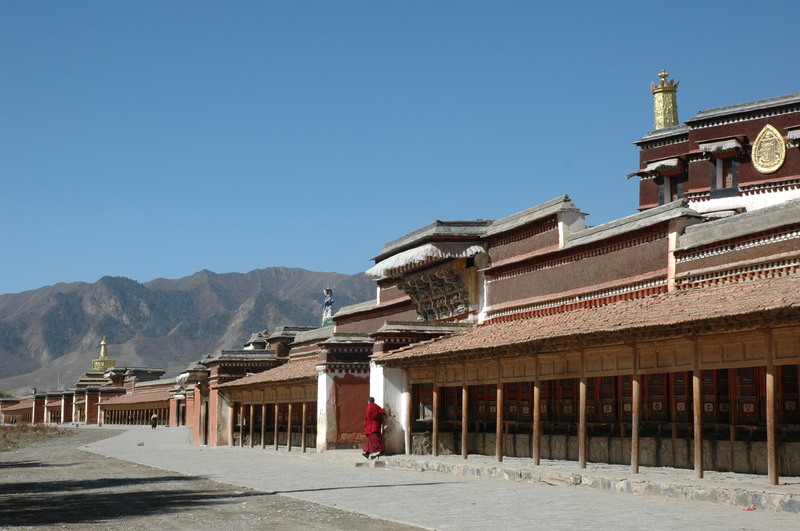
It’s home to the centuries-old Labrang Monastery, one of six important monasteries of the Gelugpa order (the Yellow Hat sect of Tibetan Buddhism – I couldn’t resist and even bought one of their yellow mohikan hats!). I used my days in Xiahe to soak up the atmosphere, immerse myself in Tibetan Buddhist culture and do some deep soul-searching and spirit cleansing. Each morning I joined the pilgrims on the 3km (clockwise of course!) route around the monasteries, turning each of the 1174 prayer wheels along the way. My faves are the big prayer wheels that you need to walk around to turn, and after each revolution a little bell goes “ding”! I was luckily able to sit in some of the decorative and colourful prayer halls with monks during prayer (although even after talking to some of the young monks I’m still bamboozled by what goes on in there…), and I even dabbled in a bit of “Om Mani Padme Hom” chanting along the way. It’s really been a great and relaxing few days here. I could stay a month.



I was in Xiahe for several days and so took one day to visit the Ganjia Grasslands, a large expanse of open grassland some 30km away well up on the Tibetan plateau. The Tibetans graze their yak herds in these pastures over the summer. I saw a few nomads up there – no yurts here though, just tents – but unfortunately most of the herds have been driven down from the summer pastures already (it’s really cold here once the sun goes down and there have been some snowfalls on the upper reaches of some of the mountains nearby). I was however able to visit a traditional Tibetan village which was surrounded by a very old and crumbling mud brick wall. They really rough it up there, and you could see everyone preparing for the coming winter – stacking firewood, dung and feed for the animals, repairing the roads and roofs etc. – which I’m sure is really harsh and unforgiving.


Further up the dirt road was another monastery at the base of a very beautiful mountain range, complete with limitless views over the grasslands. The Tsewey Monastery is a different sect to those found in Xiahe, but I wasn’t able to glean much more than that because no-one spoke English and my Tibetan is completely non-existant (they even speak a local dialect of Tibetan here so what hope have I got)! Although one interesting difference I did observe is that they went around everything counter-clockwise.


One slightly grisly discovery was a sky burial site nearby. The Buddhists here believe that once a person dies the soul leaves the body, and they dispose of the body by sky burial. First (and unlike the Zoroastrians, if anyone read my Iran blogs earlier) they dice up the body into limb-sized pieces and then let the vultures pick the bones clean. There wasn’t much to see really, just a patch of ground with lots of old rusty knives lying around, but the huuuuge vultures circling high overhead was kinda spooky.


Last point: Xiahe has really just been found out as a great tourist destination, and the tour buses have only started rolling in over the past few years. One reason I really loved the place is because there weren’t a lot of tourists around, either Chinese (my Mandarin phrasebook even proved pretty useless) or gweilo . I hate to think what the place is going to look like in five years – so get here quick!!!
The town of Dunhuang turned out to be a pleasant little place, without much of a built-up town centre and thankfully without the massive, wide and soul-less streets that have greeted me at every town I’ve visited in China thus far.
I’d heard from a few travelers about some massive sand dunes on the outskirts of town, so I rented a ricketty old Chinese bike and rode out there one afternoon. The gigantic Sahara-esque dunes loomed up hundreds of metres above the desert floor and were an impressive sight to ride towards. Of course there’s a but tho… What I wanted was an empty stretch of desert to take some cool sunset pics, but what I got was a Chinese theme park! First up there was the 80 yuan entry fee just to get in (to climb up some dunes?!?), which at $10 might not sound that steep but when it’s double what I’m paying for my accomodation it seemed like a bit of a rip-off. I first tried to ride my bike around the edge of the dunes to find the end of the fence, but they seemed to have thought of that as it keep going and going. I grudgingly paid the entry fee, along with just about every Chinese person on vacation in China it would seem . The place was packed.
I wandered around for a while, amused and slightly miffed at how well the Chinese can fuck up an otherwise beautiful place. Everywhere I looked I saw groups of tourists on camels being dragged across the dunes by a guide, each of them wearing the most ridiculous bright orange booties to stop any sand from entering their shoes. And each slope of the sand dunes has been converted into an amusement park by some entrepreneur or another who all charged ridiculous prices to slide down the slopes on a sled or inner tube.


I love the orange booties and the numbered camels – very “authentic”.
I climbed up one of the larger dunes to get away from the tourist scene; it was tough, slow going in the deep sand and I’ve still got about a kilo of sand in my shoes even as I write this. As I neared the crest of the dune the wind started to pick up – cool pics of the sand but not so good for the camera! I also noticed an ominous looking darkish cloud on the horizon. At the top I snapped off a couple of pics of the desertscape but couldn’t help noticing that the same cloud was much closer and coming my way. I remembered a huge sand storm that blew into Melbourne when I was a kid and this looked just like that, so on that hunch I started legging it down the dune. Sure enough it turned into a wild sandstorm with whipping winds, choking dust and visibility down to about 20 metres. With nothing at all left to see I rode back into town – which was an experience in itself! I knew my mujaheddin headscarf would come in useful somewhere…


(L) See the two specs on the dunes? These guys picked a bad day to get adventurous! (R) Uh oh looks like trouble brewing…


(L) Argh it’s coming my way! (R) Chinese tourists. Hilarious.
The real highlight of a trip to Dunhuang are the Mogao Caves, and they were OUTSTANDING! Well worth the effort (and the price of 120 yuan!!) to visit, which is a first for this trip in China – everywhere so far has been overpriced and has underwhelmed.
The hundreds of Buddhist caves line the cliff of a shallow valley about 25km south-east of the town. Historically the caves were an important centre of Buddhist learning and worship, and from around the 4th Century AD to the end of Silk Road trade (around the 1400’s) many wealthy merchants and officials sponsored the creation of new caves on the site. In its day, traders and caravans would take a long detour to visit the caves to either give thanks for a safe return, or to pray for a safe journey through the dangerous lands to the west.
The only way to visit the caves is on a two-hour tour, no cameras or bags permitted (doh!), and the tour guides take groups around and open up some of the hundreds of caves to see. The artistry within the caves was truly incredible, with hundreds and hundreds of elaborate statues, carvings, beautiful frescoes and paintings, most in fantastic condition after more than a millenium. You could also easily pick out the different influences (Indian, Tibetan etc.) in caves from different periods, even though I find Buddhism really difficult to get my head around because it’s so complex and minutely nuanced.
The biggest statue there is a 35m tall seated Buddha, which we were told makes it the third largest in the world (not including Bamiyan in Afghanistan which the Taliban destroyed). It was damn impressive! My favourite cave, and we saw about ten, had a large reclined Buddha (Nirvana we were told) with 72 statues representing the disciples surrounding it. We were also shown some of the many thousands of important manuscripts and exquisite silk paintings plundered by western archaeologists in the early 20th century (which you can now find in Britain, France, the USA etc.).


The gigantic sitting Buddha is built into the cliff face, behind the temple structure shown here.
I flew into Urumqi late and, after much haggling with a taxi driver, found a cheap hotel right near the train station (no shower though). After a quick six hours sleep I woke up the next day and caught a taxi to the bus terminal. My plan was to head south-east to the town of Turfan, about 2.5 hours away. I’d then see a few of the sights around there before racing back to Urumqi to collect my overnight train ticket from a black market dealer at 4pm (it’s a national holiday all this week so the trains are chockers and it’s really hard to come by tickets the “official” way).
It was past midday by the time I got to Turfan, and I knew I only had about 1.5 hours to see a few of the sights. So I chartered a taxi and off I went! First stop was the ancient city ruins of Jiaohe, on the outskirts of town. As it was made of mud brick, the centuries haven’t been kind and there unfortunately wasn’t that much to see. Some of the Buddhist temples were still somewhat visible, but that was about it. What made the visit interesting was the geography. The city was built in the middle of the desert on top of a naturally fortified “island” between two river beds.


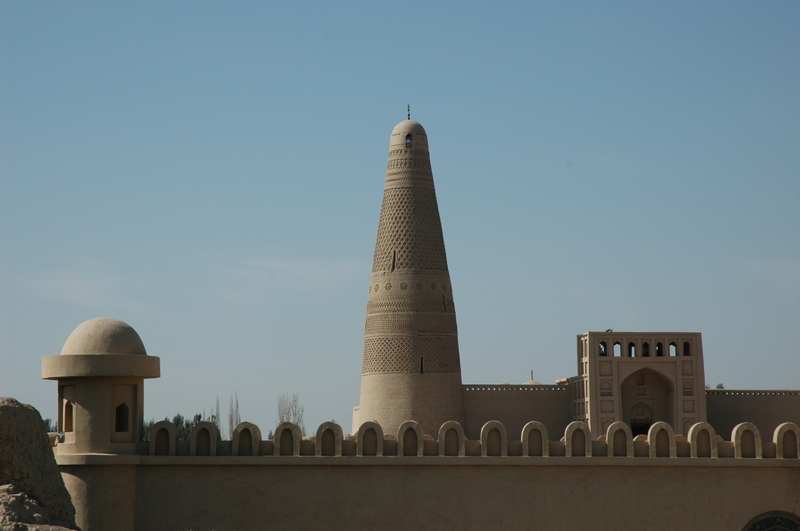
En route back to the bus terminal I had time to sneak in one more attraction – an architecturally interesting minaret in front of one of the mosques in town. Enough said.
I made it back to Urumqi half an hour late but was able to collect my ticket – phew! Chinese sleeper trains turned out to be a surprisingly pleasant experience. The carriages are much newer than a lot of the trains you’ll come across in countries like Italy or France, and the sleeper cabins were actually more spacious and had heaps more room for backpacks and suitcases. The beds had linen and pillows provided, and the rooms supplied with hot and cold drinking water for endless cups of tea and ramen noodles. I had a great sleep as the train trundled 14 hours across the deserts of Xinjiang and Gansu, and woke up feeling pretty good this morning. I’m now in Dunhuang, another desert town and former Silk Road city, and also home of the World Heritage-listed Mogao Caves.