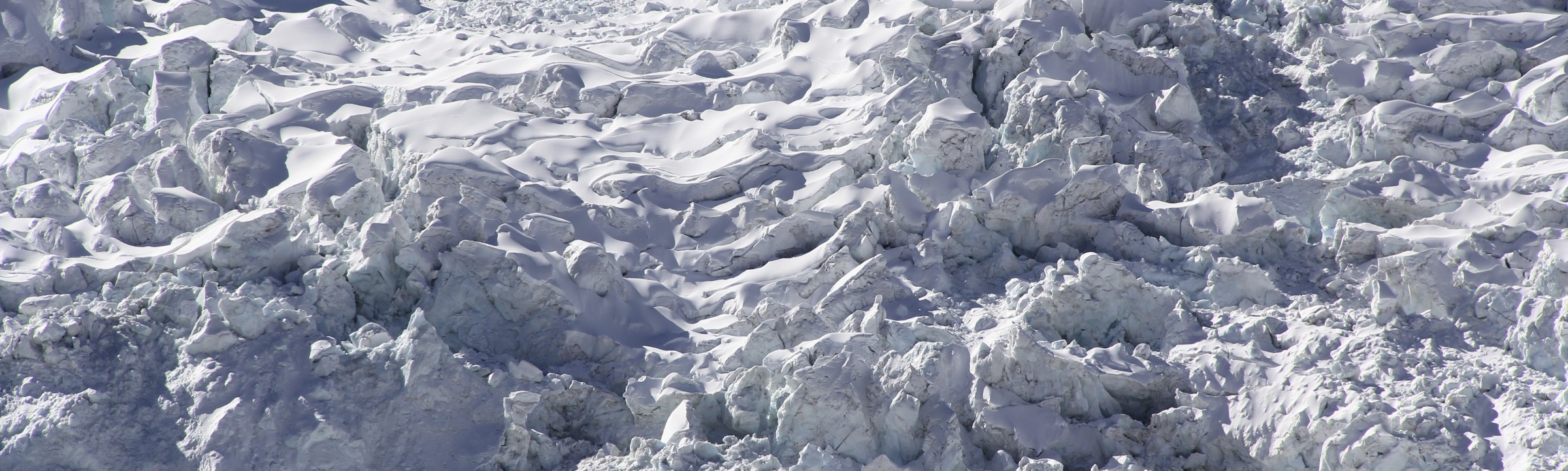
We spent a day in El Calafate to have a well-earned break, unwind and recover from our climb. We however couldn’t leave Calafate without seeing the world-famous Perito Moreno Glacier 80km away, and took the bus out there in the morning.
Now I’ve seen a lot of glaciers in my time, but this one was DEFINITELY a stand-out! It was huuuuuge, spilling down from the Ice Cap to the west and something like 3km wide at its front. The face itself stood over 50m high above the lake, which was filled with ice bergs that had broken off from the glacier, and the colour of the ice was a deep and ethereal blue. The whole thing was incredibly dynamic as well: every minute or so some pieces of ice, most small but sometimes large, fell off the glacier and into the icy lake. To top it off you get to enjoy this spectacle just some hundred metres or so away on a peninsula that nudges the front edge of the glacier. Awesome!!!

A huge chunk of ice falls off the glacier and into the lake.


Me with lots of ice. More ice.


The fellas, just happy to be warm and dry for once…

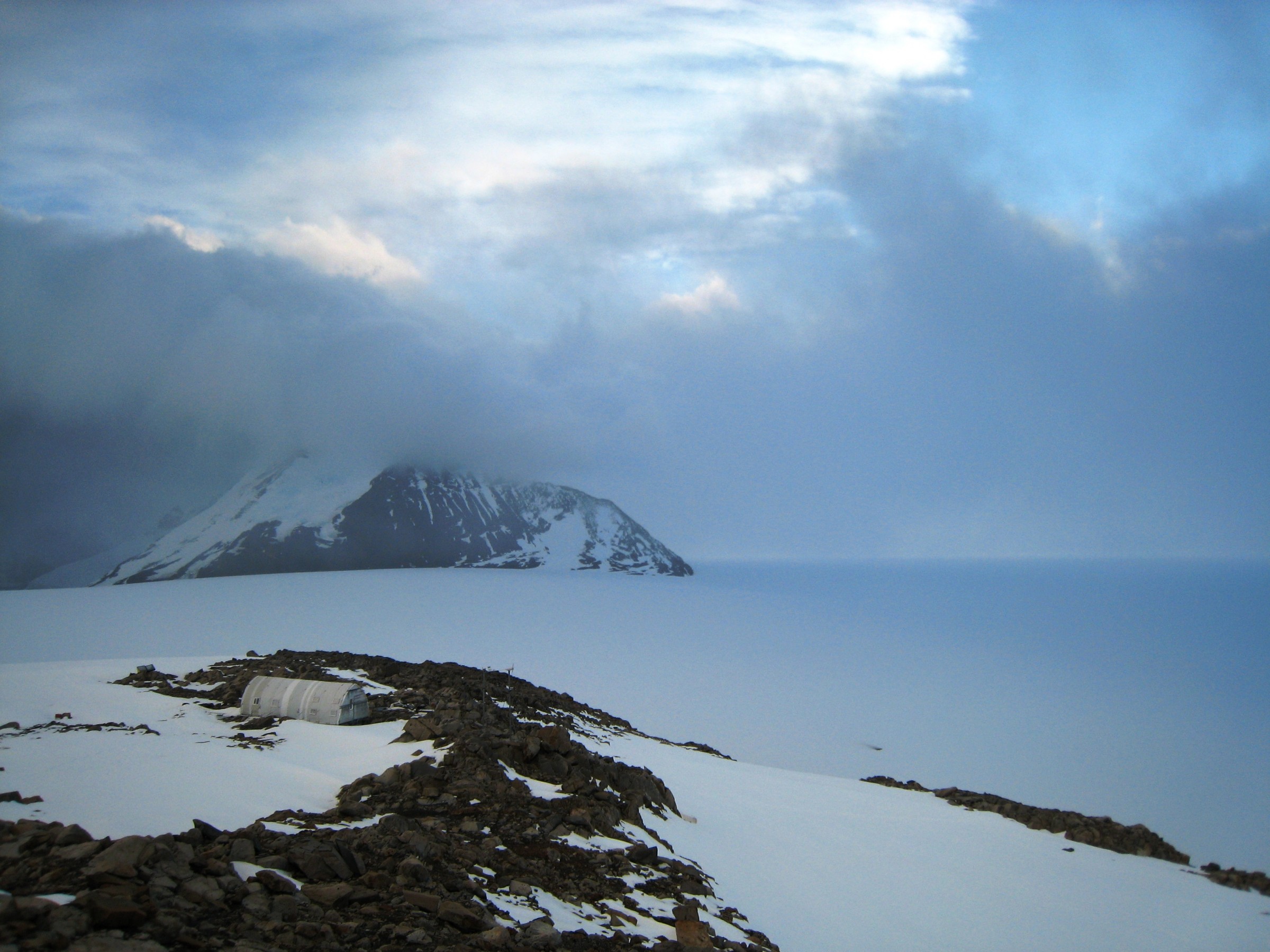
I remember the first time I heard of the Ice Cap (also called the South Patagonian Ice Field or the Continental Ice Cap), many years ago now as I was just getting into the mountain scene. I was flicking through a Macpac outdoor gear catalog from NZ and they had a full double-page photo of their expedition tent, the Olympus, illuminated at dusk on the Ice Cap, surrounded by craggy peaks and an endless tract of ice. The photo alone was enough for me to go out and buy the tent (at enormous expense I recall – I was still a uni student), and I had a burning desire to go and experience the Ice Cap for myself someday.
I was back in Switzerland earlier this year and found out that my Irish mate Mark McCarthy, with whom I used to work at ALSTOM, was also planning a trip down to Argentina around Christmas. We swapped notes and it seemed like we were on the same page, 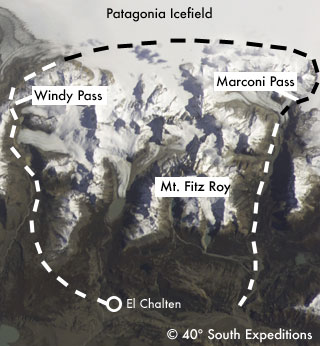 so we decided to head to Patagonia together. We started to formulate our plan: a circuit around the FitzRoy massif including a short traverse of the Ice Cap (Campo de Hielo Sur in Spanish) past the western side of famous Cerro Torre and Campo de los Altares.
Mark had already been in Buenos Aires a couple of days by the time I flew back in from San Francisco, and we had one night to get all our gear organized (and believe me there was a lot of it!) before we flew to El Calafate the next morning, not quite as far as Ushuaia but just about as far south as you can fly. A boozy farewell on our final night in civilization ensured that we were both feeling a little rough as we stepped off the plane and into a very cold and windy Patagonia. We raced around El Calafate to grab all the last bits and pieces we needed to head up into the mountains – all our food, fuel for the stove etc. – and were able to grab the early evening bus that took us four hours north to El Chalten.


(L) At El Calafate airport. (R) Food shopping – with backpacks.
Weather-wise we expected the worst. We’d heard nightmare stories about Patagonian weather (in the summer) and were prepared to not see a thing through the cloud, be rained and snowed upon every day, and be blown clean off our feet by the incessant wind. Already after half a day at close to 50 degrees south we’d quickly learnt how the “Roaring Forties” and “Furious Fifties” got their name – and both of us have a renewed respect for any sailor that rounds Cape Horn! But the weather gods were kind to us that day, and driving towards El Chalten we were blessed with clear views of Mt Fitz Roy, Cerro Torre and the rest of the Fitz Roy range at sunset. It was a beautiful view and we went crazy with photos, thinking this might be the only thing we see for the next week or so.

Beautiful Fitz Roy, with Cerro Torre to the left. The Ice Cap lies behind the mountain range.


Sunset en route to El Chalten.
We arrived late in the evening in El Chalten, a town that has sprouted up in the past few years as the tourist dollars have started flowing in. It’s a cute little village without a sealed road or a set fo traffic lights, and it had a bit of an alpine/frontier feel to it. Our bus dropped us off at one of the larger hostels in town and we were lucky to get a double room for the night. We did a last sort-out of our gear and had an early night, knowing we probably had a big day ahead.
We woke up early and made a bee-line for the National Park office. We wanted to notify them of our trip plans and find out a little more about the route we planned to take. They turned out to be next to useless for information (weather forecasts, trail info., camp sites etc.), but we were able to work out that, due to the prevailing wind from the north-west, we were best to do the Vuelta circuit anti-clockwise (instead of the original direction we researched), which would give us the wind to our backs on the Ice Cap. That change meant that we had a much easier and shorter walk in on the first day from our drop-off point up the valley to a small refugio. Now not pushed for time, we went and had a final slap-up meal in town after we’d been to the police station to get our permits that would allow us to leave and re-enter Argentina – our route took us across the international border along the Ice Cap and into Chile.


Registering at the National Park office.
After a good final feed we got a taxi to drive us some 20 minutes north to the trailhead. We then had a cruisy three hour hike up the valley to the refugio. The weather was pretty miserable (light showers and lots of wind) but we made good time there. Rather than pull out the tent and get it wet on day one, we took bunk beds at the refugio, and rather than start working through our food rations, we ate a huge meal prepared by the refugio.


(L) At the trailhead. (R) Looking up the valley at what’s to come.


(L) Arriving at Piedra del Fraile. (R) Our gigantic and delicious last supper of lamb with carrots!
The next morning it was still blowing a gale and still raining, but a glance up the valley revealed the chance of some better weather up that way. We could see a part of the glacier we would be ascending, and the clouds seemed to lift around corner at the edge of the Ice Cap, so we decided to give it a shot, knowing that there was a camp site we could stay at if need be by the lake. After the first hour, which was an incredibly hard slog upwind into driving rain, we arrived beside the lake. Some incredibly poor route markers meant we ended up off the track and we wasted quite a bit of time scrambling over rocks. We eventually found the path again and followed it along the lake, over loose boulders and up into the glacial valley.
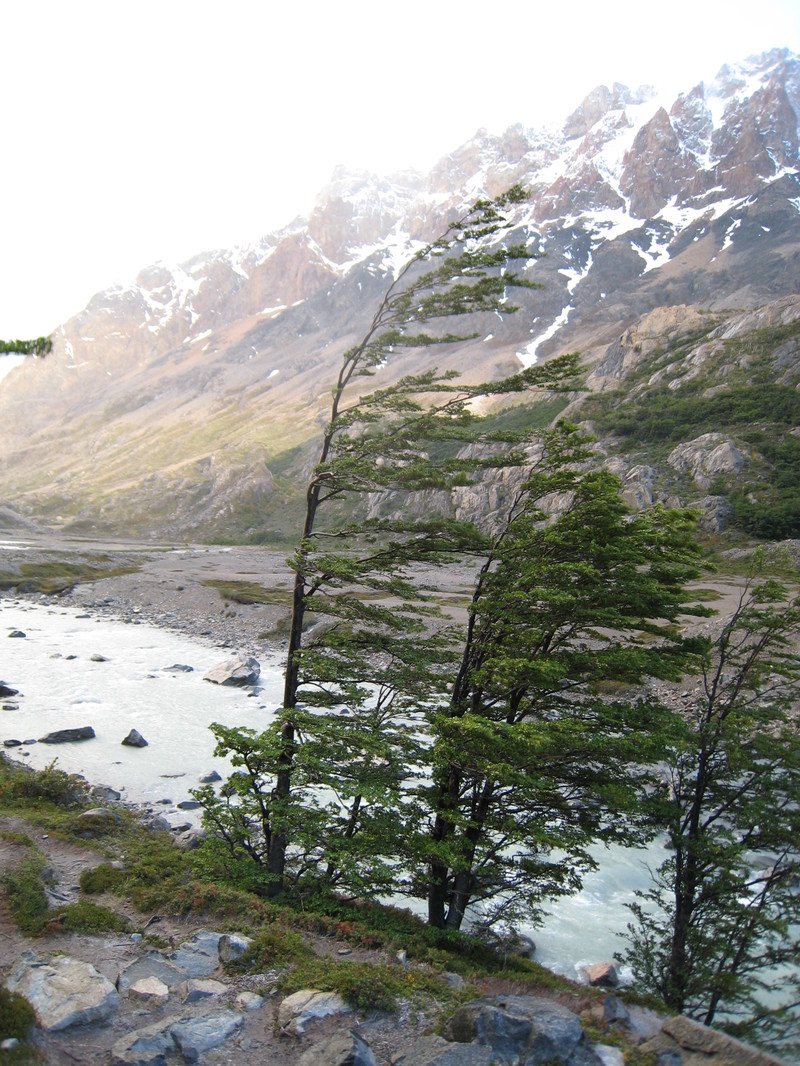

(L) Now that’s a head-wind! (R) Surf’s up at Lago Electrico.

Off route and tough going across the grain, through loose vegetation and into a wind strong enough to knock us off our feet.


(L) Uh oh, don’t get the boots wet! (R) Time for a hot brew.
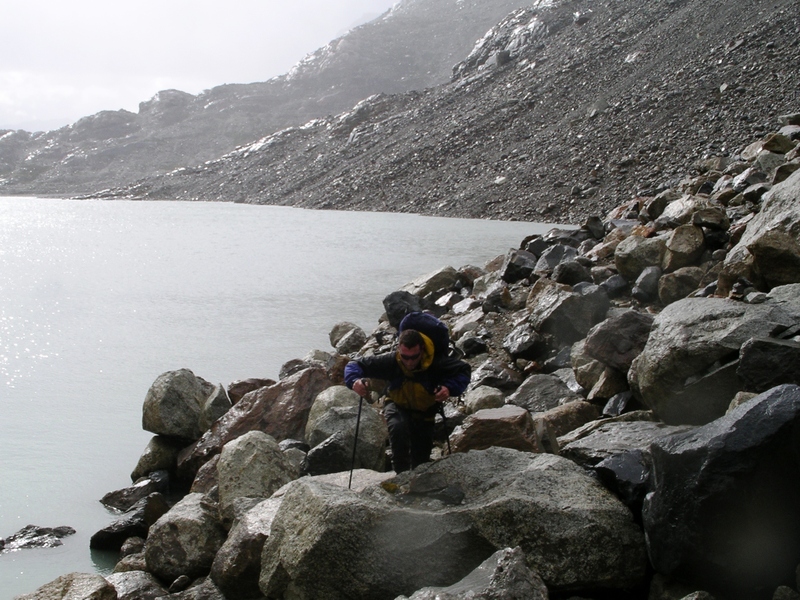
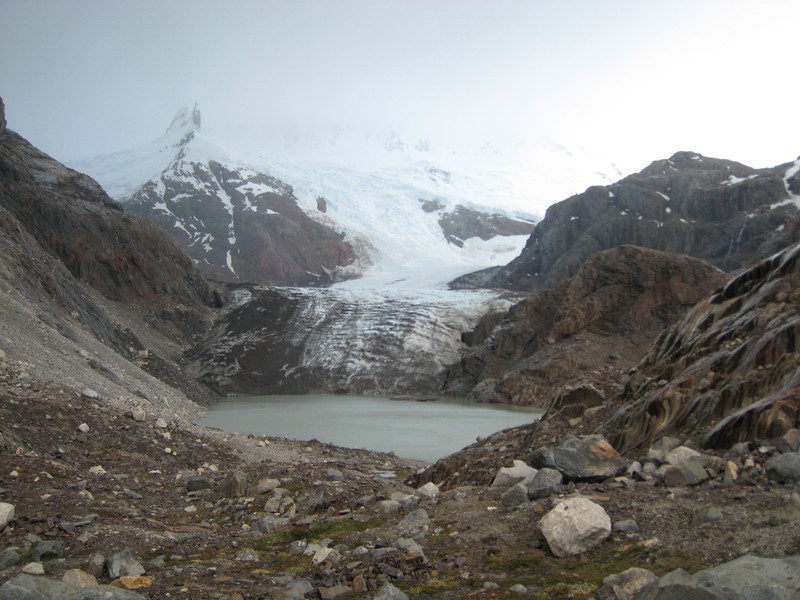
(L) Feeling the weight of the pack. (R) Nearing the face of the glacier.
After some three or four hours more we finally arrived at the moraine at the edge of the glacier, and took some time to gear up. We took every precaution as we didn’t know what the conditions would be like on the glacier: we used crampons and ice axes, roped up, and both of us had ice screws handy to use if one of us did fell down a crevasse. As it turned out the glacier was bare with no snow covering it – this is “safer” as you can generally see the crevasses – and so the going was pretty good. It took some time to find a safe route across the first glacier that avoided the heavily crevassed areas and we made pretty good time on the ascent.


We stuck to the left-hand side of the glacier, avoiding the largest, most obvious crevasses.
We climbed onto the second glacier and had a much-needed break sheltered out of the wind behind a small pile of boulders. We’d been going for a good seven hours and knew we had a lot more ahead so we took the chance to eat some much-needed food. In the wind – you have no idea how strong it was!! – there was no chance of lighting the stove so we opted for dried apricots, chocolate and nougat. We knew the steeper and more technical section was still to come and we could see the route up the glacier ahead.


(L) The route ahead, up and to the right. (R) The final ascent up onto the Ice Cap.

Mark powers up Marconi Glacier as the weather starts to close in (again).
We approached the final, steepest section of the climb, a mixed snow/ice ascent up the right-hand edge of the glacier with a dodgy looking cluster of overhanging seracs to the left-hand side (that we duly avoided). On the icy lower section we remained unroped and climbed at our own pace, pausing when the wind gusts were at their strongest – they roared down the glacier and brought stinging snow drifts with them that forced us to turn our faces away. When the ice turned to snow cover we decided to rope up, as we were concerned about hidden crevasses.

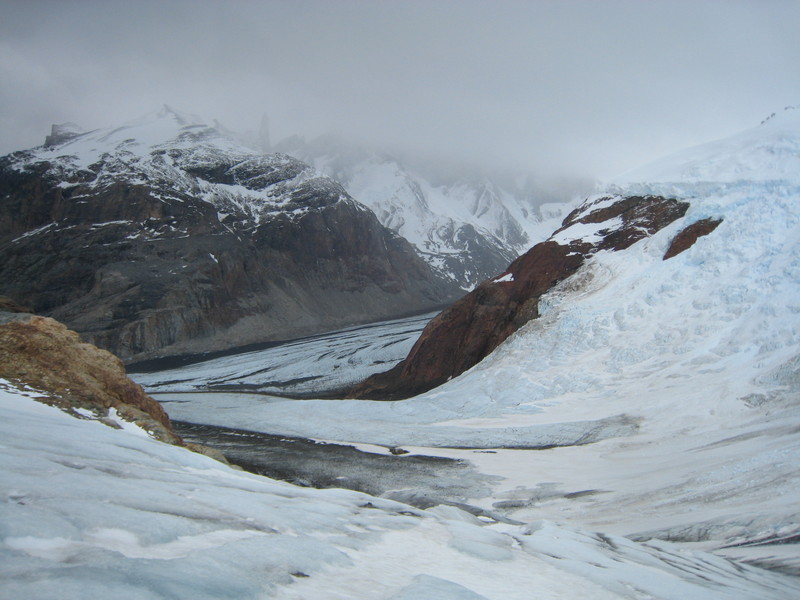
(L) Roping up. (R) Looking back down the valley.

A tough slog! Steep ice with a loose covering of grainy snow – not the most solid footing.
After 12+ hours of climbing both Mark and I were exhausted. We knew we had passed the steepest section, but we couldn’t judge the remaining distance we had to cover and the time to cover it, the light started fading and the storm didn’t look like abating. We made the decision to move off to the side of the glacier, find a sheltered spot and set up camp. After searching for ~30 minutes we both realized that we couldn’t find anywhere sheltered from the wind in the inhospitable landscape we were surrounded by, and eventually settled on a small patch of snow behind a number of boulders. As darkness fell we dug out a snow platform and set up the tent in a roaring wind. I put on a brew and we hunkered down for the night.


(L) Camp 1, with collapsed cornice. (R) Drying out after a wild, stormy night.
The storm had calmed a little by morning, and we were quick to get going and finish our ascent before the window closed. We packed up camp, roped up, and worked back onto our route up the glacier. Within an hour however, Mark wasn’t feeling 100% and wasn’t climbing strongly. After we spoke I had to respect the fact that my climbing partner wasn’t feeling quite confident about the day ahead, so we turned around and descended part of the glacier to set up camp behind some smooth bedrock. The rest of the day was spent going crazy in the tent while the storm picked up again.
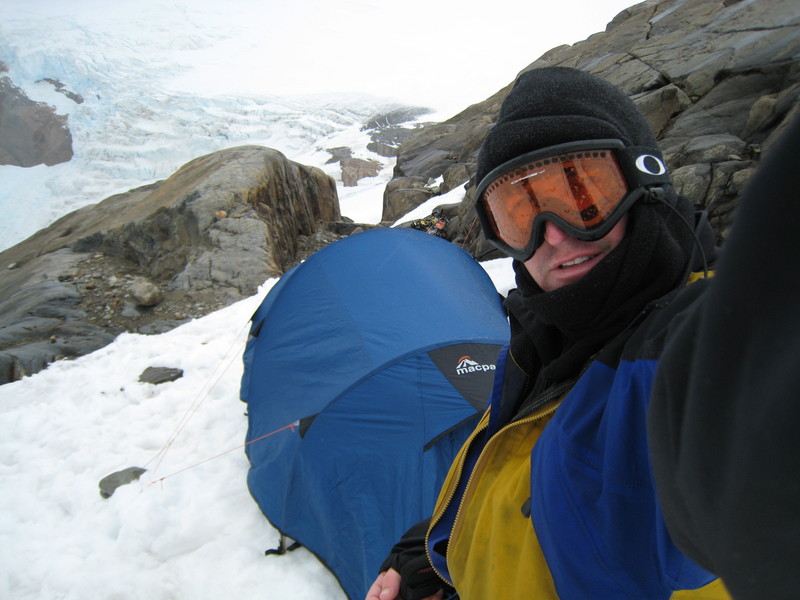

(L) Camp 2 – we didn’t get far. (R) Sitting out the storms = boring!

Our room with a view.
By next morning neither of us were feeling confident that the conditions would improve. Mark wanted to descend the mountain but I was able to sweet talk him into remaining where we were for the day, to see if the weather would clear (my MBA colleagues will be pleased to hear I even employed a decision tree as a persuasive tool!).
With only a few hours of daylight remaining I styuck my head out of the tent and felt that the clouds were lifting and the winds dying down. Mark was extremely dubious but gave me the benefit of the doubt. We packed in a hurry and started ascending once again. After an hour we were making good progress and were incredibly surprised to see another climbing team descending the glacier – the first people we’d seen in days! We stopped to swap notes with what turned out to be an Argentinian team and learnt that they’d been stuck up on the ice cap because of the storm as well, and were using the weather window to descend.
Seeing the other team boosted our confidence immensely, and we continued our ascent as the gradient leveled off. As we climbed the weather kept improving, and before long we had sun and blue sky (although the wind was still incessant). After an hour of walking we finally spotted the Patagonian Ice Cap to the west, and we were both elated!

Woohoo! We get our first view of the Ice Cap.


(L) Mark checks our GPS bearing against the compass. (R) Looking back at the way we came.


(L) Knackered, but elated! (R) Mark can’t believe his luck.
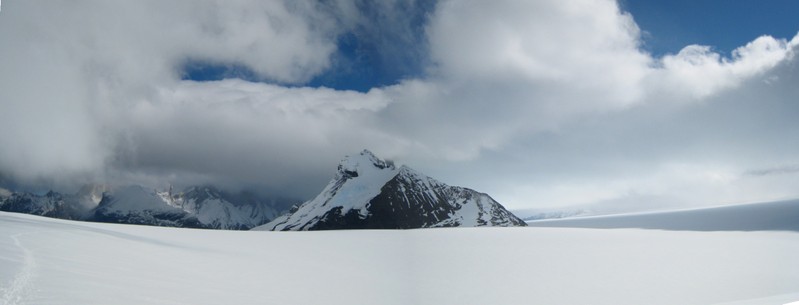
What a sight! Fitz Roy Massif to the left, the Patagonian Ice Cap to the right.
Text to come…

Home Sweet Home for a night: El Refugio Chileno, at the edge of the Ice Cap.


Text to come…

A German expedition heads south onto the Ice Cap towards Los Altares.


(L) My Mawson shot. (R) Da fellas.

Outside the refugio, preparing for the descent.

Tough going across the ice on some really crusty snow… and 30kgs on your back doesn’t exactly help! But what a view!!!
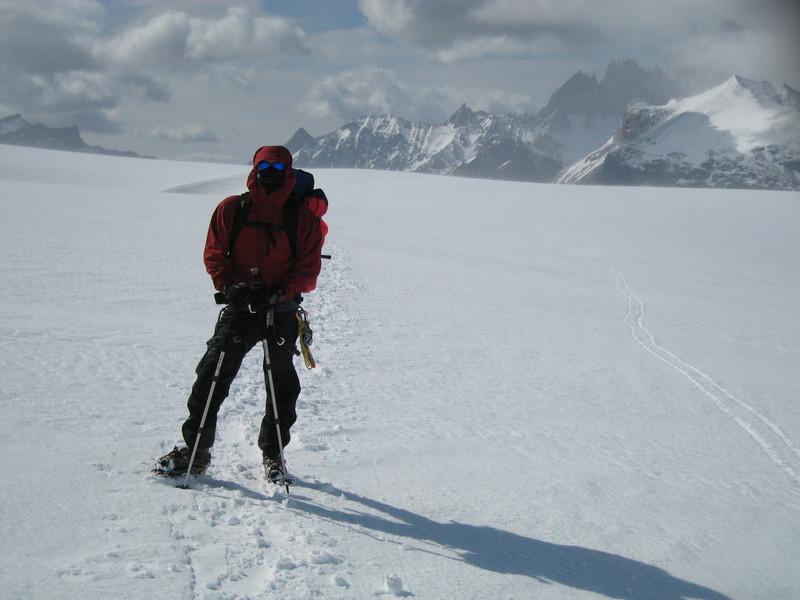
Mark during the descent – looking every part the Antarctic explorer – with our first glimpse of Fitz Roy in the distance.


Clearer weather on the descent.
 Celebrating our success back in El Chalten in typical Argentinian style – a giant steak and a bottle of Malbec! Both of us looking a little windswept there…
What can I say, I loooooooove this city!!!
I’ve been here for a few weeks now and am really getting into it. I arrived after a hellishly long trip across the Pacific. I first had an 18 hours stopover in Auckland overnight which sucked (ever wondered who “that guy” is sleeping on the lounge at the airport – that was me), although I did fill the time in by going into town to watch some international rugby on the teev at a bar along the waterfront. A long-haul flight got me to Santiago, Chile, where I had yet another stopover. The final flight from there to Buenos Aires was an experience as the plane had to ascend over the Andes, which rise straight up to the east of Santiago. I had a great view of Aconcagua, the 7000m giant, out my window.
I’ve been taking a super-intensive Spanish language course the past few weeks at the Ibero Spanish School, which had been great but tiring. After six hours of Spanish each day (four hours of small group with our fantastic teacher Julio plus two hours private lessons with the delighful Romina) I’m pretty shagged, and then have to crank out a few hours of homework once I get home in the evening. But I’ve been amazed how much it’s possible to learn in such a short time. I’ve completed  both the beginner level courses and can now stitch together some fairly reasonable Spanish. I’m pretty chuffed, and really fired up to learn more. I’d like to get my Spanish to a true “conversational” level proficiency before I leave South America next year.
The “Principiante I” class (from L to R): Me, Petrus, Alex, Jake, Julio, Louise, Jessie, Will.
The school placed me in an apartment about 25 minutes walk from the school and it’s been really nice to unpack my bags and call a place “home”, even if just for a little while (Buenos Aires is going to be my “home base” for the next several months). There are a couple of other students staying there, and the landlord Patricia has been great helping me get settled in. I really enjoy the walk to school every morning, which takes me through a very typical part of residential inner-city Buenos Aires and gives me the chance to lap up the great atmosphere of the place.
I don’t know what it is about this city but it really has me hooked! (If Bain had an office down here I’d be putting in my application for a transfer right now… 🙂 As it is I’m already thinking of ways I can get back to South America in the future!) And that’s coming from me; I’m not generally a big city kinda guy! It takes a lot for me to really love a city, and that’s even after I had my wallet pickpocketed on my first day on the crowded Subte (subway).
It’s hard to put a finger on exactly what it is, this place is just so, well, um… cool. It has a really great vibe and is a LOT of fun. I was told it’s the most “European” city in South America and while it does have a slightly European bent to it it’s most decidedly a Latin American city – together it’s a great mix! One of those cities you really have to “experience” and not just see. There’s always something going on at night or on weekends that just can’t be missed. And when I say night I meant the whole night! Porteños eat super late, sometimes at 10pm but more like midnight, and it’s only after about 1am or 2am that the clubs and bars really get going. I’ve seen the sun rise far too many times in this city…
I’ve taken some tango (of course, this is the home of tango after all!) and salsa classes, and tried out my suave moves (ha ha) at a few of the clubs. One great experience was a visit to a popular milonga, where all the locals go to dance tango. It’s great to watch (and just a little daunting!) because most of them are outstanding dancers. I didn’t think much of tango when I first saw it, it didn’t have the same high-energy sensuality of salsa, but after my first class I was hooked. It’s so, so sexy…
I wouldn’t say Buenos Aires is the most attractive city I’ve ever seen, but it has its moments. Recoleta is really pretty and its famous cemetery really interesting, La Boca’s Caminito is worth a visit, they have spruced up the old Puerto Madryn port area and it’s now a cool place to chill or eat a good meal, and strolling through San Telmo during the Sunday market was a great way to while away a few hours. There are some grand old buildings and much of the architecture gives the streets a Parisian/European feel. The trees lining the streets also add some much-needed green (the jacarandas were in flower when I first arrived with their purple bloom).


My biggest gripe is that the city needs more parks. Lots more. A few other annoyances include the prolific dog shit, which is absolutely everywhere. Yucko. You really have to watch where you walk! Then there’s the rubbish along the streets. People put their bags out to be collected but they’re soon rummaged through by a collection of recyclers (looking for cardboard, bottle, cans etc.) and dogs. The end result is a huge stinking pile of mess that ends up being blown up and down the street. And finally there are the buses: old, crowded, confusing, polluting, noisy. They run along every (and I’m not kidding) street so you can’t escape them, and it’s made worse by the wafer-thin pavements which mean you cop a big faceful of diesel fumes each time one goes by.
But, all that said, this city gets two very enthusiastic thumbs up from yours truly!!!


With my private tutor Romina. The graduating “Principiante II” class.